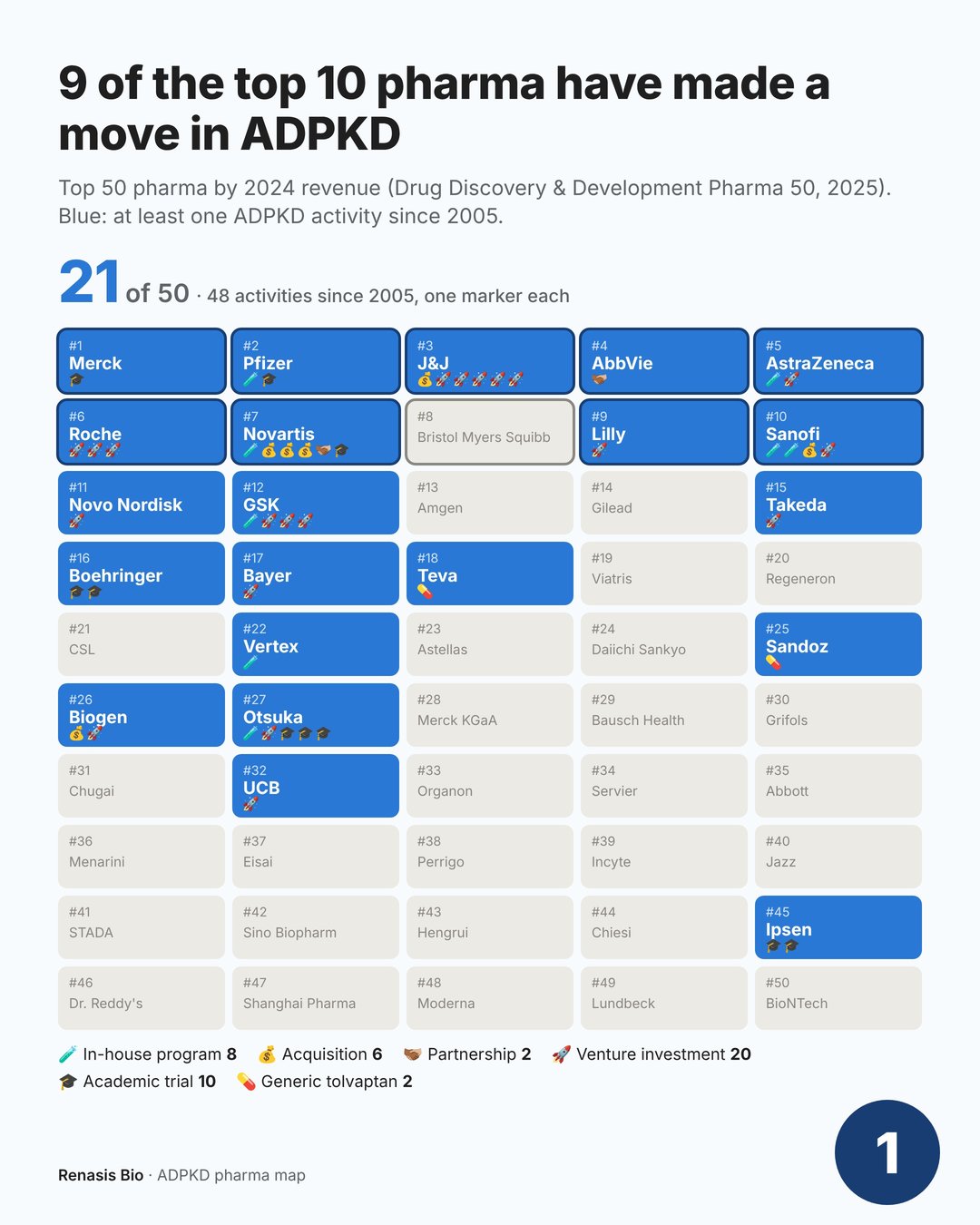
9 of the 10 largest pharma companies have made a move in ADPKD. 21 of the largest 50.
Including:
- Novartis: acquired farabursen from Regulus, $0.8B upfront, up to $1.7B total
- Vertex: PKD1 corrector VX-407, in Phase 2
- AstraZeneca, GSK and AbbVie/Calico: antibodies in the clinic
- Bayer, Biogen, J&J, Otsuka and UCB: joined ~$100M rounds for preclinical startups
Who
Claude and I mapped every ADPKD activity by the 50 largest pharma companies, total 48 activities since 2005:
- 🧪 8 in-house programs
- 💰 6 acquisitions
- 🫱🏾🫲🏼 2 partnerships
- 🚀 20 venture investments
- 🎓 10 academic trial collaborations
- 💊 2 generic tolvaptan launches
When
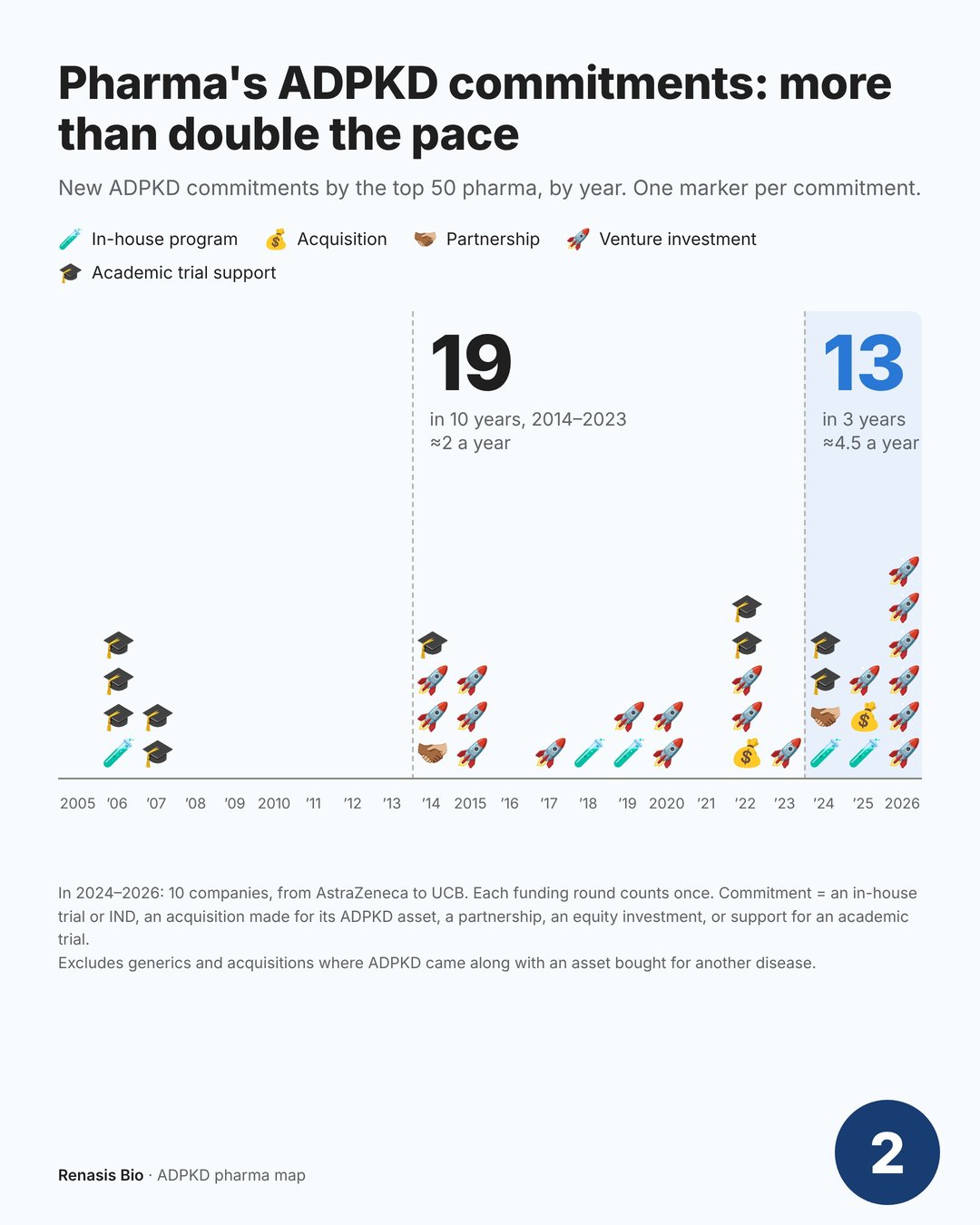
In the past 3 years, 10 pharmas made 13 new ADPKD commitments. More than double the pace of the 10 years before (19 in total).
The involvement changed not only numerically but also categorically. Startup investment leads the surge (7 rounds in 3 years vs. 12 in 10), showing a willingness to take early risk to win here. And AstraZeneca and GSK took new in-house antibodies into the clinic, showing faith in the field's economics and viability.
What
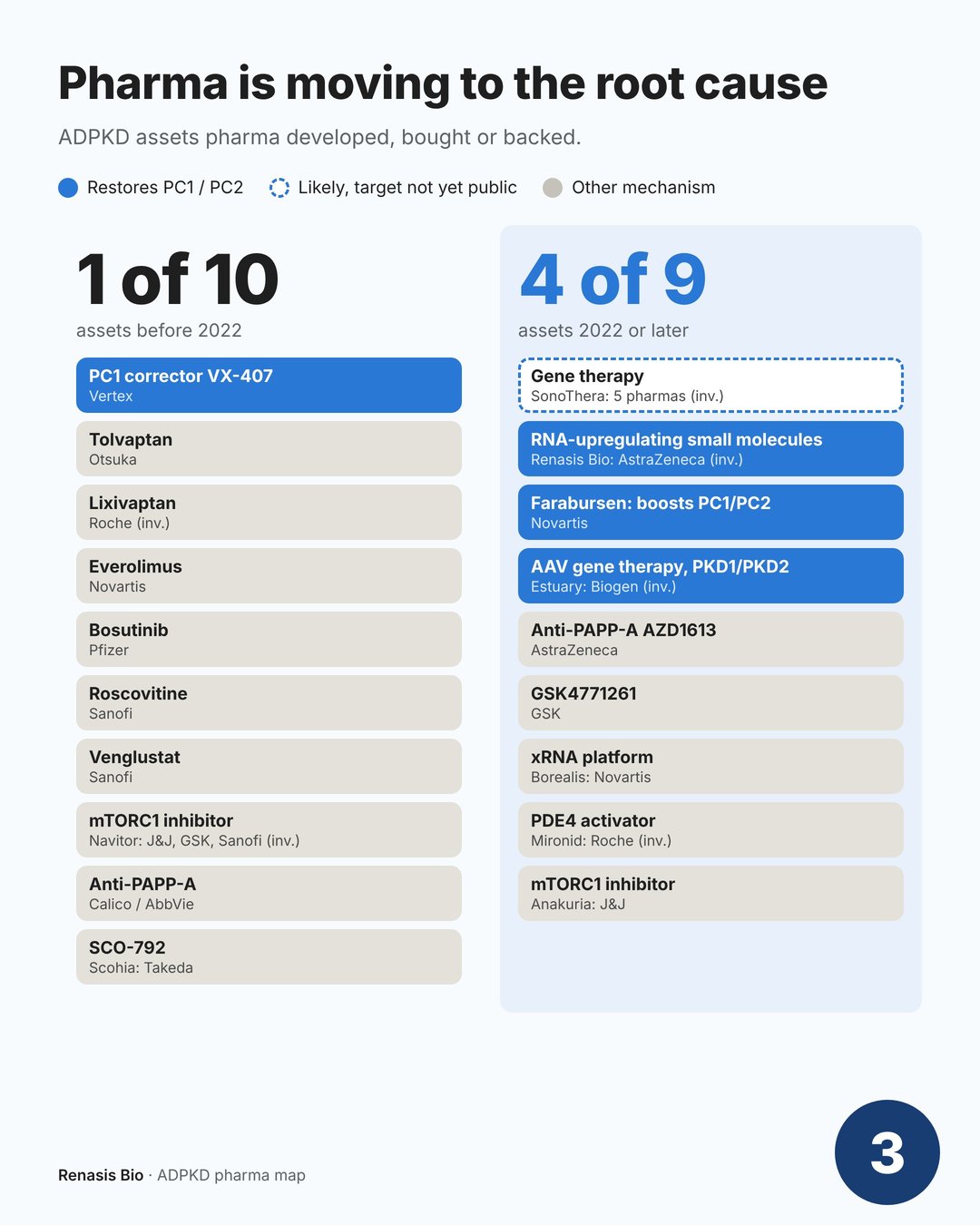
🎯 Pharma is moving toward the root cause, just like the VCs in my last post:
- 🌒 Before 2022: 1 of 10 pharma-backed assets aimed to restore polycystin (PC1 or PC2) directly.
- 🌓 Since 2022: 4 of 9.
Vertex corrects misfolded PC1. Novartis's farabursen blocks miR-17 to boost PC1 and PC2. Biogen-backed Estuary and SonoThera (backed by 5 big pharmas) are developing gene therapies.
How much
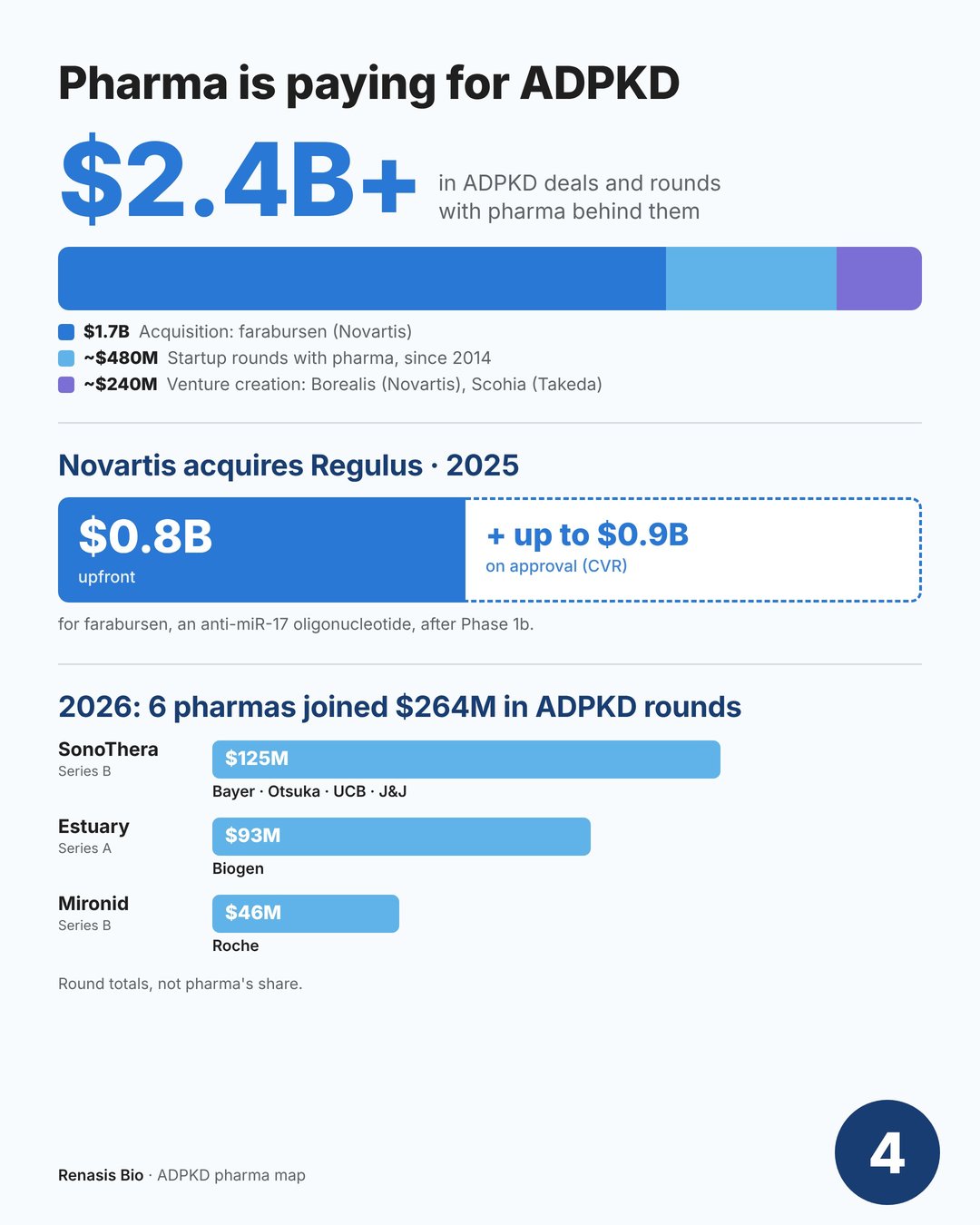
💰 The Novartis–Regulus deal is a benchmark: $0.8B upfront plus up to $0.9B more, for an ADPKD asset after Phase 1b. FDA has since agreed to a single pivotal Phase 3.
🚀 Pharma venture arms are increasingly active, too. 11 big pharmas have taken equity in ADPKD startups. In 2026 alone, 6 of them joined rounds totaling $264M.
📊 Adding it up: up to $1.7B for farabursen, ~$480M in startup rounds with pharma investors since 2014, and ~$240M in venture creation (Borealis with Novartis, Scohia with Takeda). Over $2.4B in ADPKD deals and rounds with pharma behind them.
Why
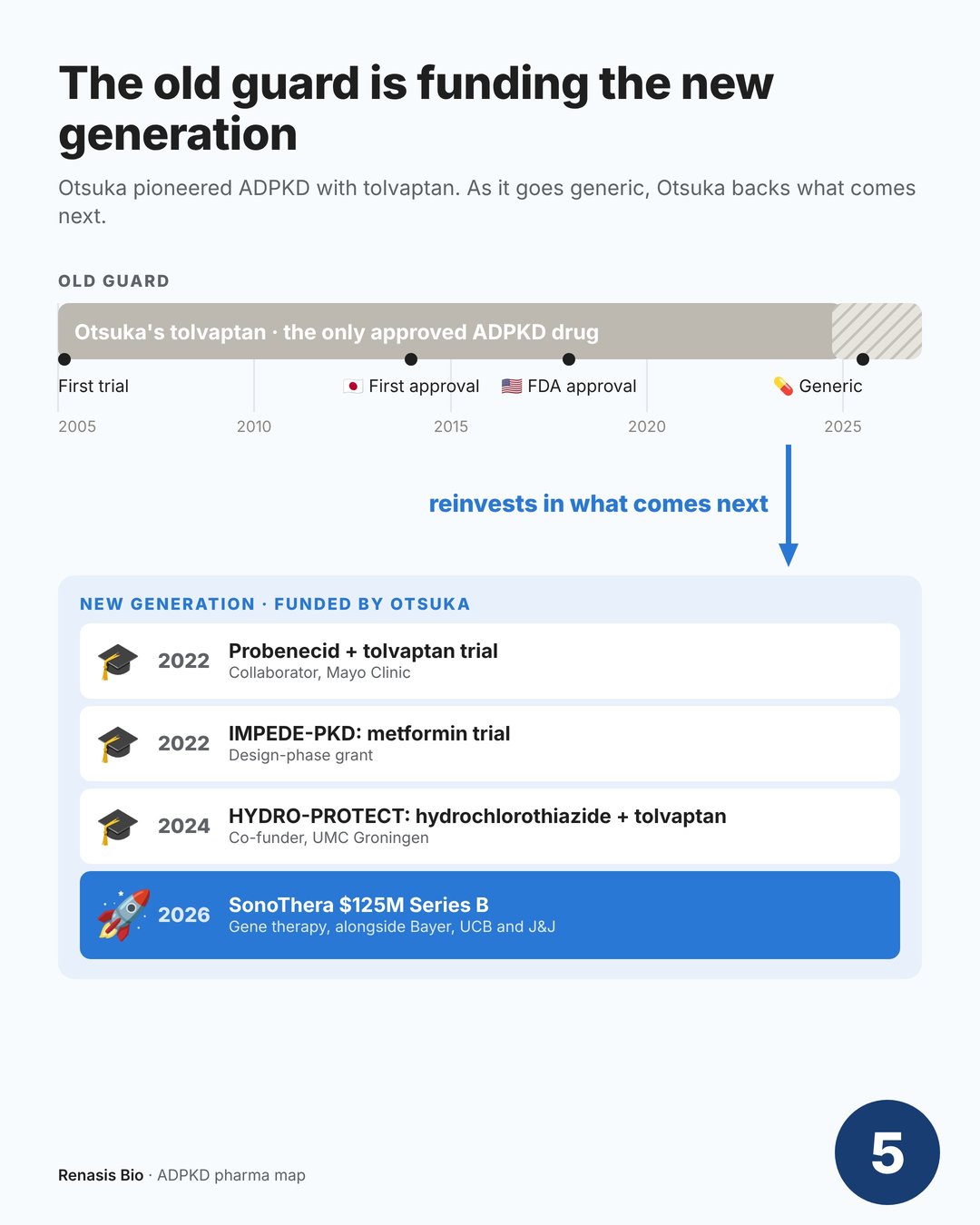
🇯🇵 Otsuka pioneered the ADPKD market. Tolvaptan was the first ADPKD drug, approved in Japan in 2014 and the US in 2018.
Now tolvaptan is generic: Lupin launched the first US generic in 2025, Apotex, Alkem and Teva followed, and Sandoz has one in Europe.
Otsuka's response? Keep investing in ADPKD. It co-funds combination trials with tolvaptan, and in 2026 it joined SonoThera's Series B. The old guard is funding the new generation.
To sum up
Pharma's growing involvement in ADPKD signals a Goldilocks moment for the field: validated and lucrative.
For patients, this is great news: pharma can take drugs all the way to them.
For startups like ours, it means exits are real, they come early, and a true pipeline play is within reach: partner the lead asset with pharma, and use that to build the platform.
Sources
- Pharma activities, deals, rounds and trials: the Renasis Bio ADPKD pharma map (48 activities by 21 of the top 50 pharma, since 2005), each activity linked to its source; as CSV: activities.csv, top50.csv, program_owners.csv, rounds.csv, round_investors.csv
- The 50 largest pharma companies, by 2024 revenue: Drug Discovery & Development, Pharma 50 (2025)
- Novartis–Regulus (farabursen for ADPKD), announced Apr 30, 2025, closed Jun 25, 2025: announcement, completion (Novartis)
- Farabursen mechanism (blocks miR-17, boosting PC1 and PC2): pharmaphorum
- First US generic tolvaptan, approved Apr 24, 2025: Lupin; US generic approvals since (Apotex, Alkem, Teva): Drugs.com, generic Jynarque availability
- SonoThera $125M Series B, with Otsuka: SonoThera